
Floundering with ADHD Emotions
By: Cynthia North, CALC
A fish is to water as ADHD to emotion. BIG EMOTIONS. Oddly, the DSM-V does not include or mention emotional dysregulation in the diagnosis criteria. The mention of emotion was taken out through revision. The DMS-III was the last issue to consider emotion (Shaw et al., 2014). Emotions are not touched on at all. How could this be so blatantly be taken out of the diagnosis criteria? Emotions are hard to measure and are on a spectrum often more acceptable and tolerated at younger ages. Clinicians found emotions to be too hard to quantitate. (“Why Am I So Emotional?” The Painful Truth: ADHD and DESR, 2021) The most significant pioneers of our time, Dr. Ned Hallowell and Dr. Russel Barkley, both express the need for emotional dysregulation or what Dr. Barkley has coined Deficit Emotional Self-Regulation (DESR) to be added to the diagnosis criteria. How or when this acknowledgment will happen is to be determined. Where does that leave you during an emotional meltdown and the chaos that will follow?
If you have experienced ADHD through a loved one or experience uncontrollable emotions yourself, you know they can come on strong and fast. Not just mad and sad but happy and exuberated. ADDitude magazine teases out some distinctions in a Q&A article written by Dr. Barkley. The question and answer response, “DESR: “Does ADHD Emotional Dysregulation Ever Fade?” especially piqued my compassion for ADHD brain-wiring and the need to cope effectively with the ADHD emotional component.
“But can emotional regulation be “trained?” In children, the chances of that are quite slim because they haven’t yet developed the appropriate self-regulation skills that such training would require. Interventions like medication, parent training, and controlling for environmental triggers may be most helpful for this stage. Adults, however, may benefit from cognitive behavioral therapy (CBT) and mindfulness-based programs especially reformulated for adult ADHD in recent books, both of which help the individual deal with many aspects of emotional dysregulation.” (DESR: “Does ADHD Emotional Dysregulation Ever Fade?,” 2021)
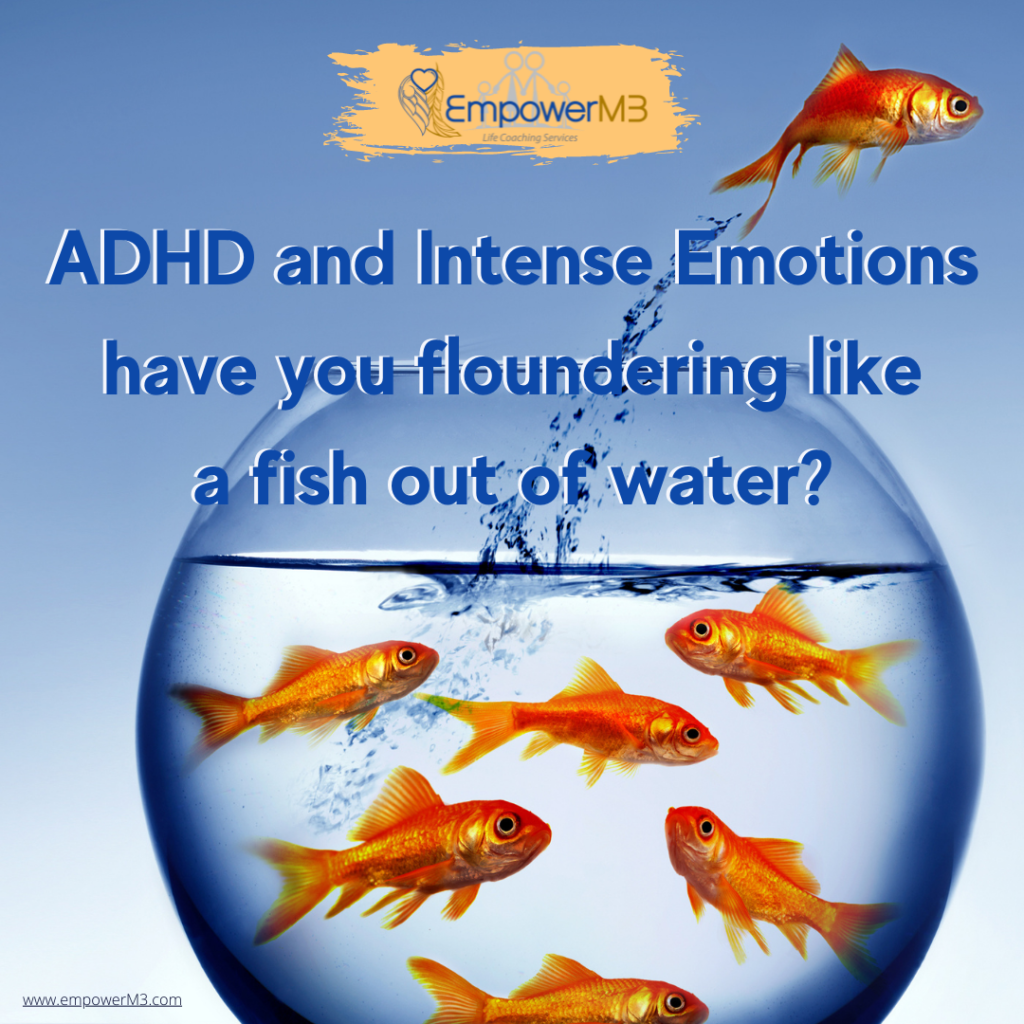
Have you ever thought about why a fish flops around when it is out of water? Without googling it, I reason, their brain is programmed to move until they are no longer beached. A fish washed ashore flops to meet the surf once again. Whew, crisis averted. Let’s take this visual a step further. ADHD emotion is like a goldfish out of water. Think about a goldfish jumping out of its bowl. Oops, forgot to think before jumping—Classic DMS-V criteria for ADHD. With ADHD, no matter how much the goldfish flops, it will not get back in its bowl alone. No matter what, you cannot train a fish or even instruct them to just jump back in the bowl. They do not have the ability to jump outside of water. It needs help. It needs help. The goldfish needs someone to see that it has jumped out of its tank. This person is likely a trusted person, a parent, teacher, sibling, friend, or co-worker. That person must know to carefully catch the fish as not to harm it during its own effort to find water and then place it back inside the water—all with hopes it will survive. That is a lot of pressure and responsibility for the caregiver. To help the goldfish, the trusted person needs awareness and knowledge.
 ADHD and emotionality is not only individual to each person, thanks to our amazing billions of neurons, but it also evolves with time as a person’s brain develops and forms from experiences. Understanding ADHD emotions requires recognition of triggers and awareness of what strategies help to de-escalate them. Most often, this process comes with trial and error and adapting. Going it alone will only keep the fish out of water longer. And with that comes danger. The repetitive bowl jumping and the pile-up of negative experiences can become overwhelming and defeating. Over time this can contribute to suicide ideation or even self-harm (CHADD, 2021). Understanding how emotions are at play with each individual’s ADHD brain style is crucial to wellness. Unfortunately, this is a huge miss in the diagnostic process.
Dr. Hallowell and Dr. Barkley are prime examples of the charge underway to embrace emotional dysregulation within ADHD. They are not alone in their pursuit. Coach’s like myself and other ADHD professionals are raising their hands to create space for greater understanding. Awareness is growing. Does emotional dysregulation have you or your loved in perpetual angst? Choose to seek professional help from a Psychiatrist or Cognitive Behavior Therapist specializing in ADHD. Organizations like CHADD.org and ADDA and publications like ADDitude Magazine can help you find your specific needs. A certified ADHD Life Coach can help create paths forward by strategizing and developing an emotional regulation toolbox. On-going research is showing efficacy in mindfulness and focused mental fitness.
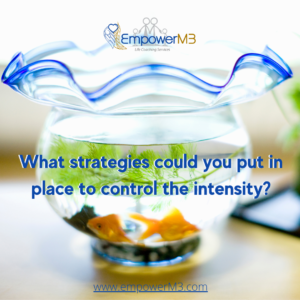
Living with emotion is part of what creates the human experience. Maintaining emotional control can be directly affected by lack of sleep, hunger, over-stimulation, and environmental sensitivities. What if you were better equipped to control your emotional output? Maybe this is knowing you need a protective cover over your fishbowl, so you don’t find yourself out of water when you didn’t remember to think before jumping. This protective cover can be what you need it to be. Maybe it is clear glass. Perhaps it provides different colored light. Or a breathable mesh. Think about it. What do you need in your toolbox to have ease and flow through emotion? Start with your bodily awareness, use your breath and choose to find your center. Breathing is the one thing you can always have readily available to you no matter where or what you are doing. Funny thing, many of us unknowingly hold our breath. Tell your brain to breathe. Oxygen is essential to have the full function of your brain. You can regain control when you feel the rise in your emotions through breath. This is just one of many tools and techniques to practice during heightened emotion that can help ease the tide. ADHD and emotional dysregulation are difficult to navigate, but through lived experience, I know there is help available. Reach out and stay safe in yourself. You are with purpose. Choose to swim forward. Maybe you could benefit from swimming with a school of fish… you do not have to go it alone. 🐟🐟
Find out more about ADHD and Emotional Dysregulation here:
Home – Dr. Hallowell (drhallowell.com)
Dr. Russell A. Barkley – Dedicated to Education and Research on ADHD (russellbarkley.org)
ADHD, Self-Harm, and Suicide – CHADD
Resources:
Shaw, P., Stringaris, A., Nigg, J., & Leibenluft, E. (2014). Emotion Dysregulation in Attention Deficit Hyperactivity Disorder. American Journal of Psychiatry, 171(3), 276–293. https://doi.org/10.1176/appi.ajp.2013.13070966
(Why Am I So Emotional?” The Painful Truth: ADHD and DESR, 2021)
ADHD and Emotions: What the DSM-5 Doesn’t Tell Us. (2020). Psychology Today. https://www.psychologytoday.com/us/blog/the-shrink-tank/202004/adhd-and-emotions-what-the-dsm-5-doesnt-tell-us
DESR: “Does ADHD Emotional Dysregulation Ever Fade?” (2021, October 11). ADDitude. https://www.additudemag.com/desr-emotional-dysregulation-adhd-answers/
CHADD. (2021, June 23). ADHD, Self-Harm, and Suicide – CH
ADD. CHADD. https://chadd.org/attention-article/adhd-self-harm-and-suicideaybe

Cynthia North is a Certified ADHD Life Coach with specific training in ADHD neurobiology through the iACTcenter and is moving towards continued coach certification with the International Coach Federation. She works to help ADHDer’s move from crippled in doubt to capable with clarity. Her passion is guiding the ADHD community to success by empowering others to shine with their abilities through positivity and realized strengths.