
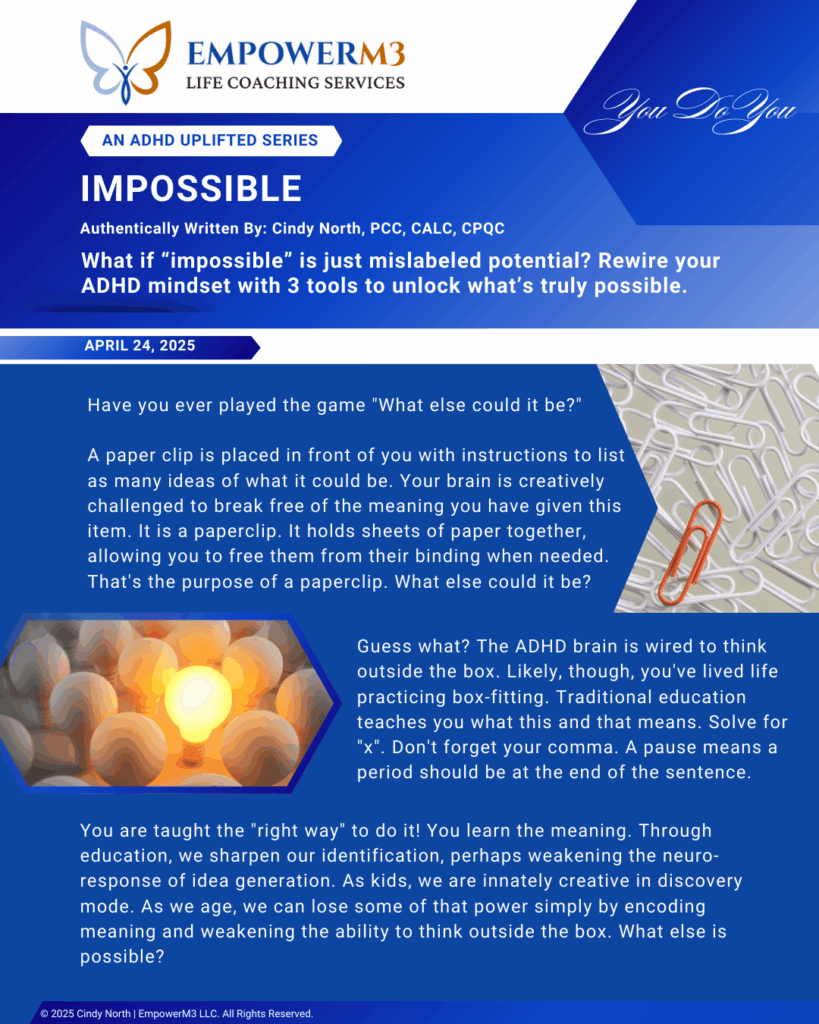
IM POSSIBLE- An ADHD uPLifted Series
Have you ever played the game “What else could it be?” A paperclip is placed in front of you, and you list as many things as it could be. Your brain is challenged to break free of the meaning you have given the object. It holds paper together, that is its purpose, but what else could it be?
The ADHD brain is wired to think outside the box. The trouble is, you have likely lived life practicing box-fitting. Traditional education teaches you the “right way,” the meaning, the rules. As kids we are innately creative in discovery mode, and as we age we can lose some of that power simply by encoding meaning and weakening the ability to think outside the box.
Impossible, or I’m possible?
Name the first thought that comes to mind when you see these letters: I-M-P-O-S-S-I-B-L-E. Your brain is likely decoding “impossible,” something incapable of being done. Or you could see IM POSSIBLE. As Audrey Hepburn famously put it, “Nothing is impossible, the word itself says, I’m Possible.” Your thoughts give the letters their meaning.
Possibility is your gateway. The brain is wired for least resistance; think of how it forces you to slow and catch your breath when running, pure survival mode. Long-distance runners train to control that response. You can train your thinking the same way.
Productive vs. effective
Being “productive” often means paying attention, thinking before acting, sleeping on schedule, managing the mundane, planning, remembering, and not losing your cool while doing all of it. That is not easy for an ADHD-wired brain. ADHD is not simply a deficit of attention; often you notice so much that everything feels like a priority and picking one thing is overwhelming. Executive functioning skills like regulation, planning, and time management can be inconsistent or missing.
So how do you do all that effectively? Thinking is powerful. What you believe is what you will do. If you think something is impossible, it most surely is. When you choose “I’m possible,” you create potential and opportunity for yourself, and that requires planning.
Three tools to hack your “I’m Possible” mindset
- Let it Fall. Visually see a thought or word fall to the ground, then choose whether to pick it up. It creates a pause between receiving and responding, so thoughts do not ride the merry-go-round in a stuck loop.
- What Else Could It Be? Catch an “impossible” thought and play the game. If that is hard, ask, “What would my best friend say is possible?”
- Entrust a Thought Partner. Ask a trusted friend, family member, or coach to help you notice when “impossible” is getting in your way and shift you back to “I’m possible.”
From birth, our brains give meaning to our surroundings, and you are constantly reaffirming that meaning with your thoughts. An ADHD brain is a supercharged power waiting for you to understand how it fires. Let’s break out of the box. There is power in your wiring, and I believe you are worthy of living ADHD uplifted.
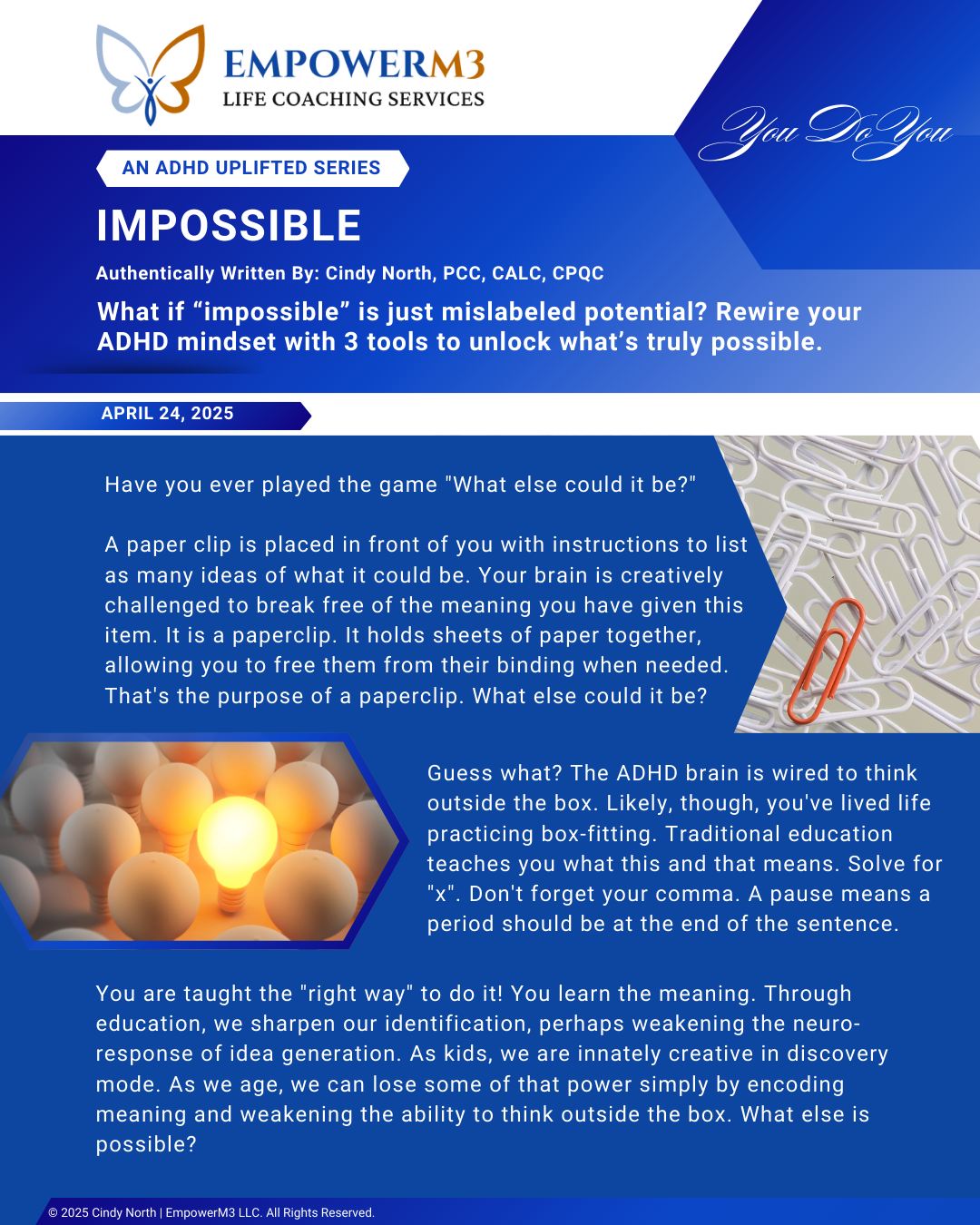
View this uPLifted issue in its original magazine-style layout.