
Permission to Interrupt: A Guide to Interrupting the Stress Cycle- An uPLifted Series- May 2024
As a society, we have let heightened stress become a normalized state of being, so much so that when a doctor says our physical symptoms may be caused by stress, we feel dismissed. “You mean I’m not having a heart attack? But I feel like I’m having a heart attack.” We have accepted living stressed as normal without knowing the true cost. De-stressing is crucial for every brain style, and even more so for differently wired brains with ADHD and executive function challenges.
What the stress response is for
Stress is a chemical process that starts in the brain, a natural response to a perceived threat. It’s what kept us safe from predators. Today the brain reads threats in work pressure, relationship issues, or money problems, and releases adrenaline and cortisol to prime a fight, flight, or freeze response. Short-term stress can be useful, helping you focus, react quickly, and meet a challenge.
Persistent stressors don’t stay contained. They make us more sensitive to daily annoyances, turning a minor inconvenience into an insurmountable obstacle. It’s like the stress dial is turned up to eleven.
When stress turns chronic
With 24-hour news, social media, and constant demands, the stress response is on a constant drip. Chronic stress sets in when you’re exposed to prolonged stress or can’t fully recover between hits. Unlike acute stress, it isn’t just a happiness drainer, it erodes your cognitive ability, immunity, sleep, and more, often in ways you don’t notice.
Common signs of stress
Stress shows up across four areas. Physically as headaches, muscle tension, fatigue, sleep and appetite changes, or digestive issues. Cognitively as trouble concentrating, racing thoughts, forgetfulness, and negative thinking. Emotionally as irritability, anxiety, overwhelm, or low motivation. And behaviorally as withdrawal, avoidance, procrastination, or unhealthy coping. Recognizing your signals is the first step to managing them.
ADHD-friendly ways to interrupt the cycle
You can’t eliminate stress, but you can interrupt it. Name the stressor out loud to make it concrete instead of a vague dread. Move your body to burn off cortisol and reset your nervous system. Use breath as a built-in brake, since slow exhales tell the brain the threat has passed. Protect sleep as non-negotiable recovery. And build in a daily “cortisol detox,” a short, deliberate wind-down that signals safety. These work for neurotypical brains too, but they matter most when your wiring already runs hot.
Give yourself permission to interrupt. You are not failing because you feel stress, you are human. There is power in your wiring, and you are worthy of living ADHD uplifted.
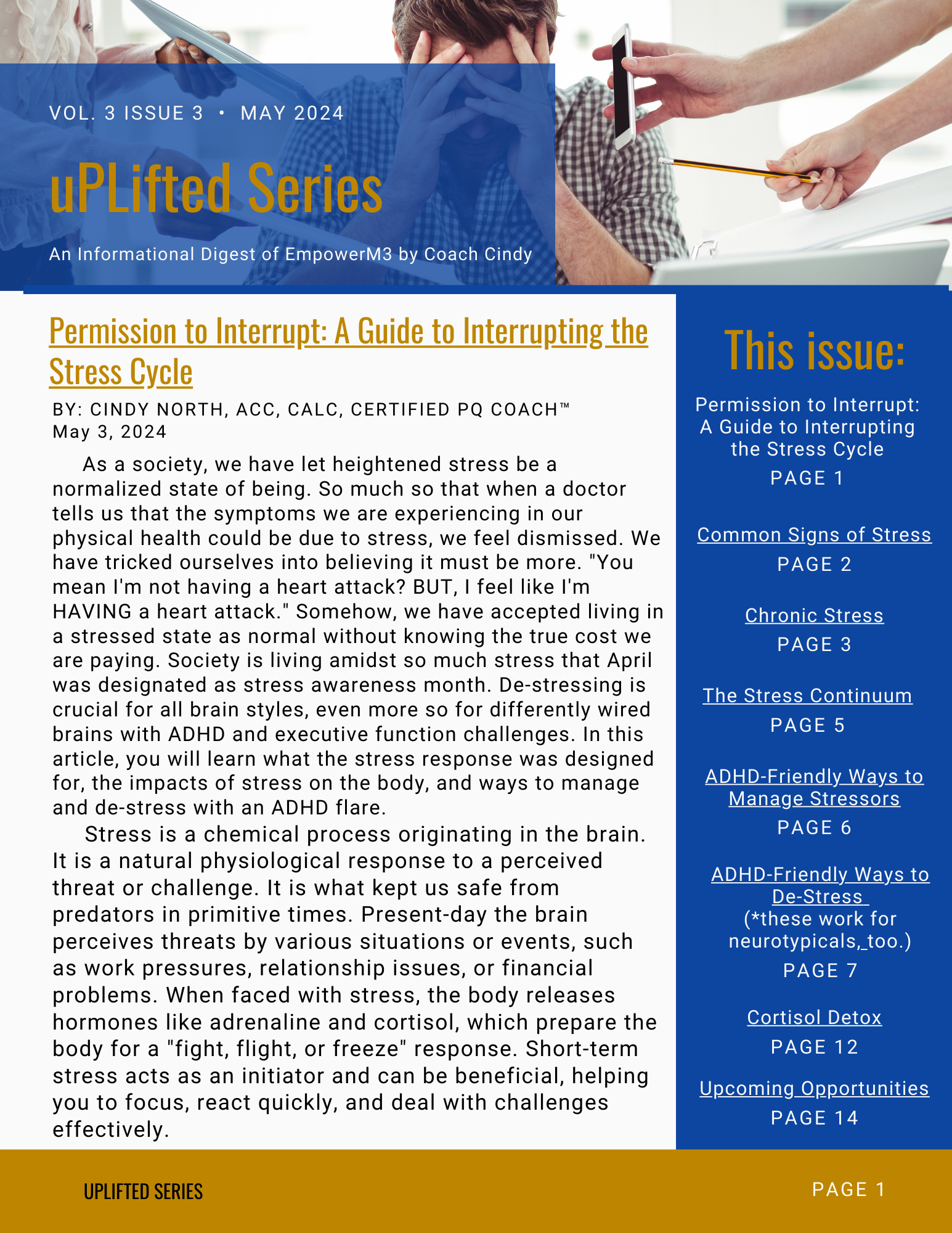
View this uPLifted issue in its original magazine-style layout.