
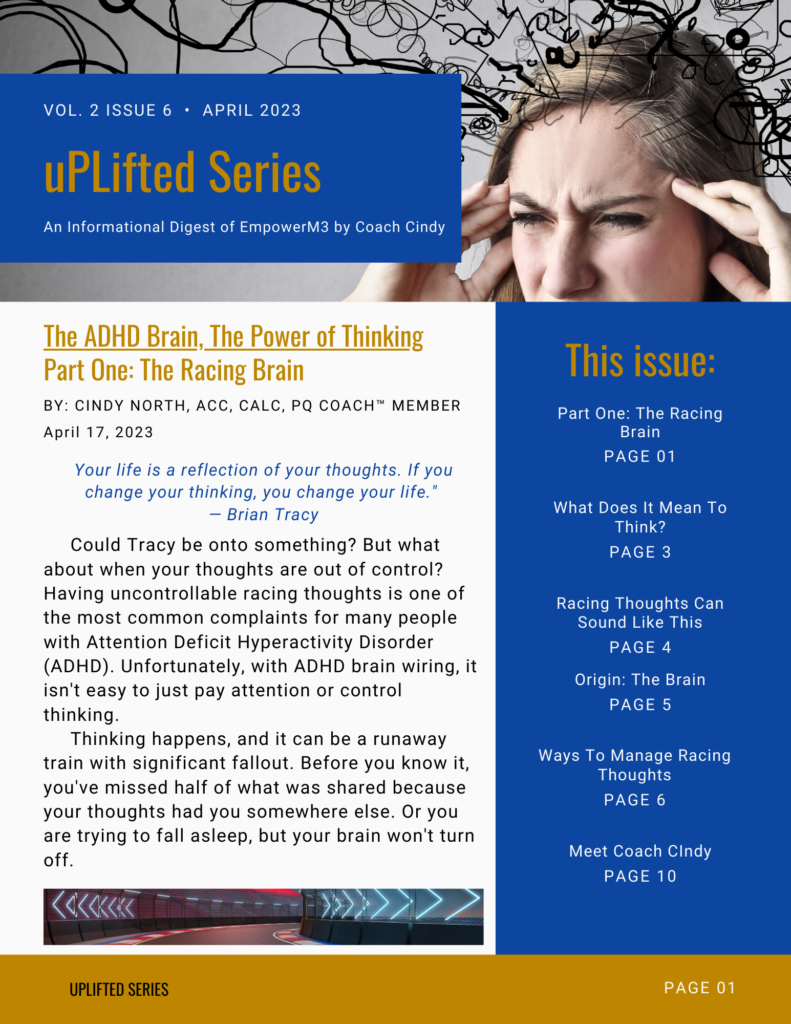
Racing Thoughts- An uPLifted Series- April 2023
Your life is a reflection of your thoughts. If you change your thinking, you change your life.— Brian Tracy
But what about when your thoughts are out of control? Uncontrollable racing thoughts are one of the most common complaints for people with ADHD, and with ADHD wiring it isn’t easy to just “pay attention” or “control your thinking.” Thinking happens, and it can be a runaway train: you miss half of a conversation because your mind wandered off, or you lie awake because your brain won’t switch off.
What it means to think
ADHD is a neurodevelopmental difference expressed as hyperactive/impulsive, inattentive, or combined, and it can affect development, neurology, psychology, and mood. It’s stereotyped as the busy boy disrupting class, but it’s just as often a silent, unseen churn in the mind. For many, a hyperactive body in childhood becomes a hyperactive mind in adulthood.
Where racing thoughts come from
ADHD affects three regions of the brain, the frontal cortex, limbic system, and basal ganglia, which shapes how self-regulation and racing thoughts take hold. Research published in Nature Communications found the average young-adult brain has around 6,000 thoughts per day. If you have ADHD, you know your brain blows past that number, and thought “stories” can run on repeat.
Ways to manage racing thoughts
Learning to direct thought and hold attention takes practice, especially for ADHDers. Externalize the loop by writing thoughts down so your brain can stop rehearsing them. Give racing thoughts a scheduled outlet instead of fighting them all day. Use movement and breath to discharge the mental momentum. And practice noticing a thought without chasing it, letting it pass rather than boarding the train. Small, repeated practice rewires the pattern over time.
This is meant to enrich the conversations you have with your medical support team, not replace them. There is power in your wiring, and you are worthy of living ADHD uplifted.
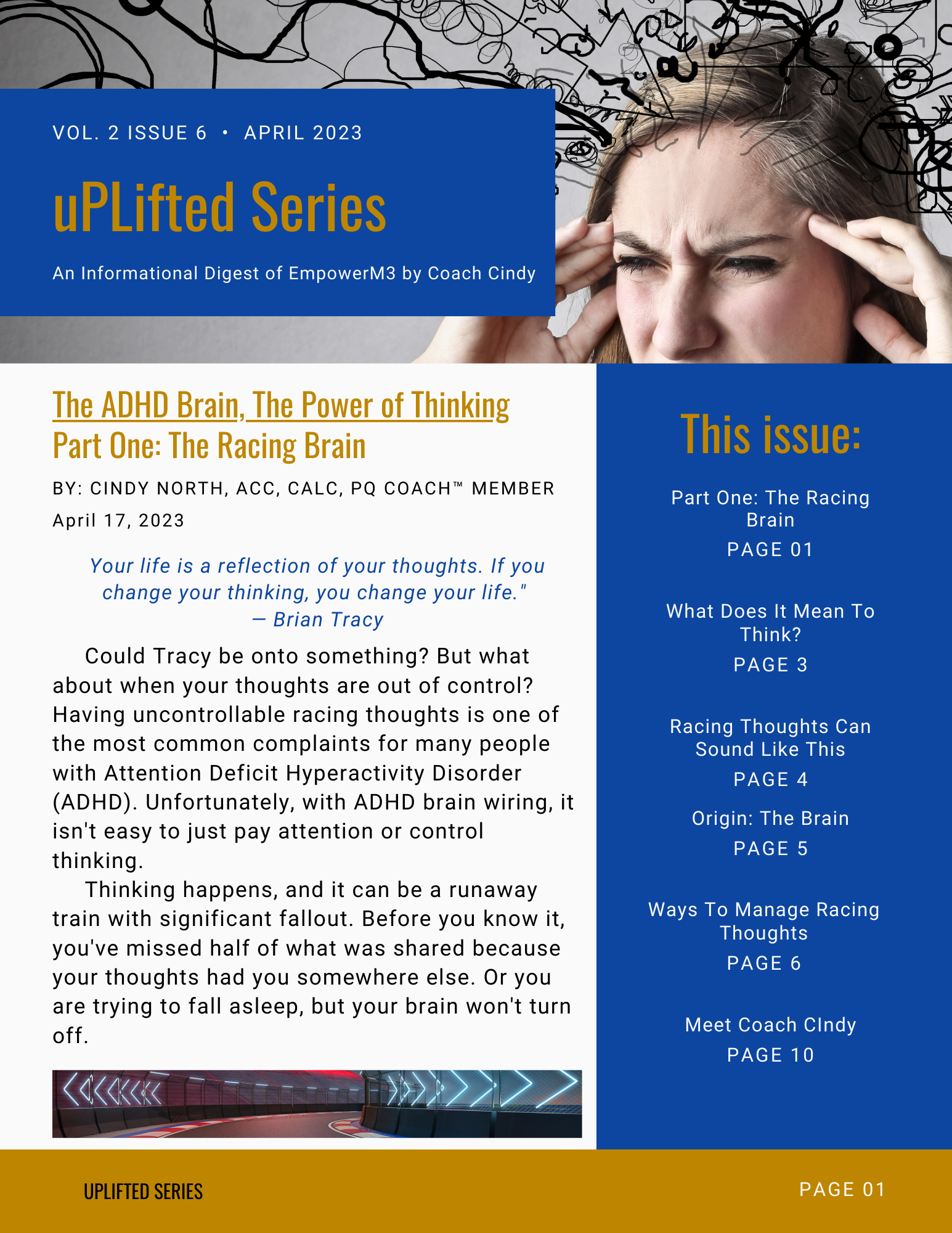
View this uPLifted issue in its original magazine-style layout.