
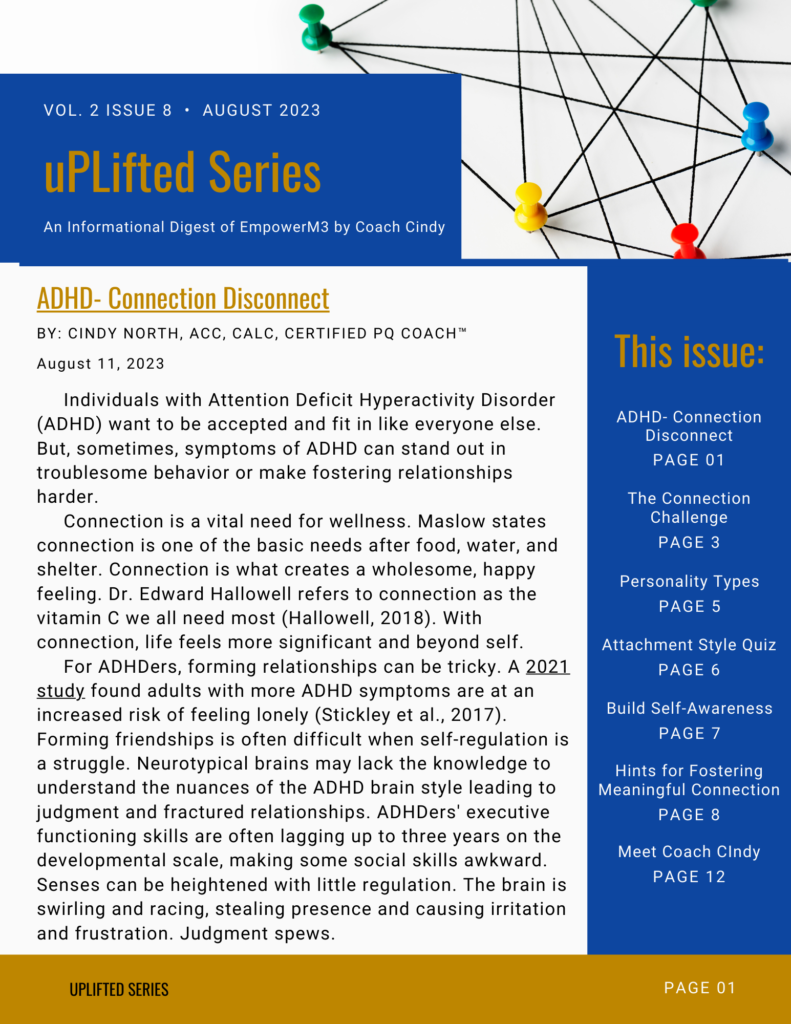
ADHD Connection Disconnect-An uPLifted Series-August 2023
Individuals with ADHD want to be accepted and to fit in like everyone else. But sometimes the symptoms of ADHD stand out in troublesome behavior, or simply make fostering relationships harder. This month I explore what I discovered about connection, where the disconnect happens for those affected by ADHD, and seven tips to foster connection anyway.
Why connection matters
Connection is a vital need for wellness. Maslow placed it among our basic needs, right after food, water, and shelter, because connection creates a wholesome, happy feeling. Dr. Edward Hallowell calls it the “vitamin C we all need most.” Yet for ADHDers, forming relationships can be tricky. A 2021 study found adults with more ADHD symptoms are at increased risk of feeling lonely, and executive-functioning skills that lag on the developmental scale can make social timing feel awkward.
ADHD is like having a Ferrari engine for a brain with bicycle brakes. Strengthen the brakes and you have a champion.— Dr. Edward Hallowell
The connection challenge
The ADHD brain is wired for interest. It isn’t that ADHDers don’t want friends, they crave inclusion. But sharing interests isn’t always easy when they run at 110% intensity, fizzle quickly, or don’t match the age-predicted norm. In 2023 the U.S. Surgeon General named loneliness the epidemic of the year, noting it can be as damaging as smoking fifteen cigarettes a day, so the stakes for connection are real.
Know your personality type and attachment style
Your personality type, introvert, extrovert, or ambivert, drives your connection needs, and it may not match your partner’s or your child’s. Attachment styles matter too, especially with ADHD wiring. The four styles (Secure, Anxious, Avoidant, Disorganized) sit on a spectrum and can differ from relationship to relationship. Understanding your own supports your ability to initiate and maintain healthy relationships.
Build your self-awareness
The most important step is becoming a curious detective of yourself, without judgment. Try asking “what” instead of “why.” Rather than “Why did you do that?”, ask “What were you expecting to happen?” What-questions unlock reflective thinking instead of blame.
Seven hints for fostering meaningful connection
- Create fun time. Designate time in your calendar for friends, or for yourself if that suits you best.
- Join or start a group around your interest. Like-minded groups are often where fast friends are born.
- Spark conversation with curiosity. Skip “How are you?” and ask something you genuinely want the answer to.
- Set the tone. Start by noticing something you like about the person; a genuine compliment goes a long way.
- Digest criticism as information. Break feedback into opportunities to grow rather than proof that you are “bad.”
- Don’t keep score. Tallying who did more feeds judgment and harms connection.
- Build trust over time. Trust grows through honesty, dependability, respect, forgiveness, and presence.
Invisible threads are the strongest ties.— Friedrich Nietzsche
Connection asks for vulnerability. Becoming your own best friend is the first step to being someone else’s. Don’t let your ADHD symptoms become your connection disconnect. Smile, it’s the first, best way to spark a connection.
View this uPLifted issue in its original magazine-style layout.